

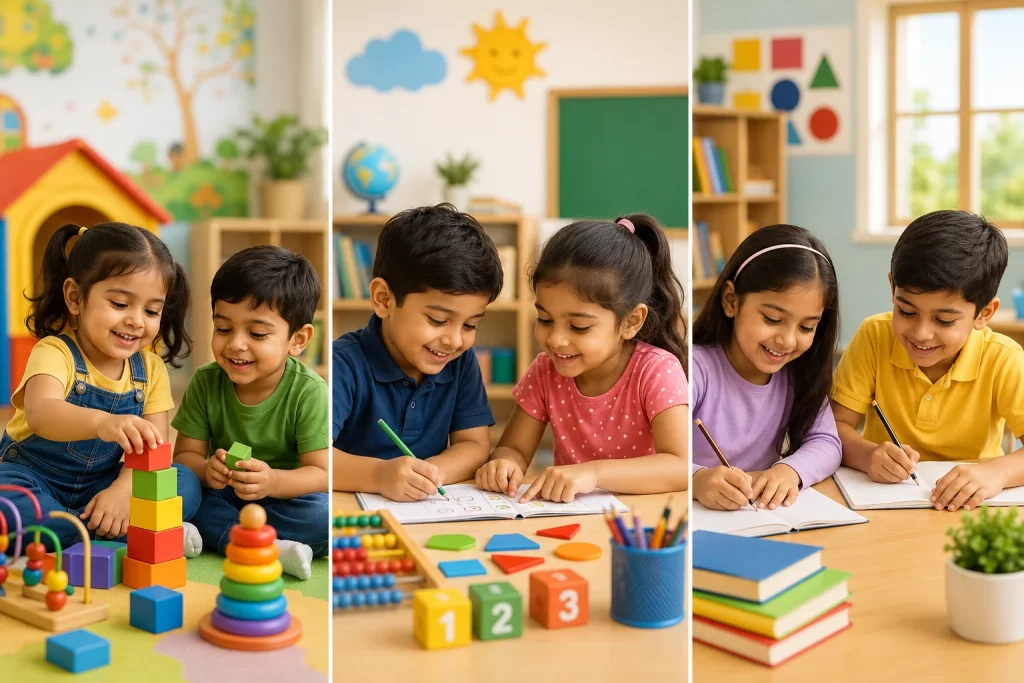
If you’re comparing a Play School, Nursery, and Kindergarten, you’re not alone. Many parents are unsure which early learning program is best for their child and when they should begin. Although these stages are closely connected, each one supports a different phase of a child’s growth and learning.
Understanding the difference between Play School, Nursery, and Kindergarten can help you choose the right environment based on your child’s age, developmental stage, and learning needs. In this guide, we’ll explain what each program offers, compare their key differences, and help you make an informed decision for your child’s early education.
Why Early Childhood Education Matters
The first five years of a child’s life are the foundation for lifelong learning and development. During these years, children rapidly develop language, communication, emotional intelligence, creativity, social skills, and problem-solving abilities.
A nurturing early learning environment helps children:
- Build self-confidence
- Develop communication skills
- Learn to interact with others
- Improve creativity and imagination
- Strengthen fine and gross motor skills
- Become emotionally secure and independent
Choosing the right program at the right age ensures children enjoy learning while developing the skills needed for future academic success.
Play School vs Nursery vs Kindergarten: Quick Comparison
| Feature | Play School | Nursery | Kindergarten |
| Ideal Age | 2–3 Years | 3–4 Years | 4–5 Years |
| Main Focus | Social & Emotional Development | Early Learning Skills | School Readiness |
| Learning Style | Play-Based | Structured Activities | Academic Readiness |
| Communication Skills | Basic | Developing | Advanced |
| Literacy & Numeracy | Introduction | Basic Concepts | Reading & Writing Readiness |
| Classroom Routine | Flexible | Semi-Structured | Structured |
Although these programs have different objectives, each one plays an essential role in preparing children for the next stage of learning.
What is a Play School?
A Play School is usually a child’s first learning experience outside the home. It is specially designed for children between 2 and 3 years of age, where learning happens naturally through play, exploration, music, storytelling, movement, and creative activities.
Rather than focusing on academics, play schools help children become comfortable in a classroom environment while encouraging curiosity and confidence.
Children at this stage learn to:
- Interact with teachers and classmates
- Follow simple routines
- Express their thoughts and emotions
- Develop independence
- Improve motor skills through activities
- Build confidence in new surroundings
A quality play school creates positive early learning experiences that children carry throughout their educational journey.
What is a Nursery School?
Nursery is generally the next step after play school and is suitable for children between 3 and 4 years of age.
At this stage, children begin participating in more structured classroom activities while continuing to learn through play. Nursery introduces basic academic concepts without creating pressure.
Children gradually develop:
- Early language skills
- Number recognition
- Shape and colour identification
- Listening and concentration
- Classroom discipline
- Social interaction
- Creative thinking
The goal of nursery education is to strengthen the child’s cognitive, emotional, and social development while preparing them for Kindergarten.
What is Kindergarten?
Kindergarten is designed for children between 4 and 5 years of age and serves as the bridge between preschool education and primary school.
Here, children become more confident learners while developing the foundational skills needed for formal education.
A Kindergarten program focuses on:
- Early reading readiness
- Writing readiness
- Basic mathematics
- Problem-solving skills
- Communication and vocabulary
- Independent learning
- Teamwork and collaboration
- School readiness
At this stage, learning remains interactive and engaging, but children also begin following a more structured curriculum that prepares them for Grade 1.
Which Program is Right for Your Child?
The right choice depends on your child’s age, developmental stage, and readiness to learn.
Play School is ideal if your child:
- Is between 2 and 3 years old
- Is experiencing school for the first time
- Needs to develop social and communication skills
- Learns best through play and exploration
Nursery is suitable if your child:
- Is between 3 and 4 years old
- Is ready for basic classroom routines
- Can follow simple instructions
- Is beginning to recognise letters, numbers, and colours
Kindergarten is the best choice if your child:
- Is between 4 and 5 years old
- Is ready for structured learning
- Can communicate confidently
- Is preparing for primary school
Every child develops differently, so parents should choose a program based on individual readiness rather than age alone.
Why Play-Based Learning Makes a Difference
Research consistently shows that young children learn best through meaningful play.
Play-based learning helps children:
- Think creatively
- Solve problems independently
- Improve communication
- Develop emotional resilience
- Strengthen social relationships
- Build confidence
- Enjoy learning naturally
Instead of memorising information, children actively participate, explore, ask questions, and discover new ideas through hands-on experiences.
This approach creates lifelong learners rather than children who simply memorise facts.
How Anandam Supports Every Stage of Early Learning
At Anandam, every program is thoughtfully designed to match the developmental needs of children at different ages.
Our learning journey includes:
- Uphaar (2 Years): A gentle introduction to learning through play and exploration.
- Umang (3 Years): Encouraging curiosity, creativity, and communication.
- Ujjval (4 Years): Building early literacy, language, and cognitive skills.
- Udaan (5 Years): Preparing children confidently for formal schooling.
With experienced educators, a safe campus, age-appropriate learning activities, and a child-centred approach, Anandam creates an environment where children feel valued, confident, and excited to learn every day.
Final Thoughts
There is no single answer to whether a play school, nursery, or kindergarten is the “best” choice. Each stage plays a unique role in a child’s growth and development.
The key is choosing a school that understands children’s developmental needs, provides a safe and nurturing environment, and encourages joyful learning instead of academic pressure.
At Anandam, we believe every child deserves a happy beginning. Through play-based learning, caring educators, and thoughtfully designed programs, we help children build confidence, curiosity, and the skills they need for a bright future.
Whether you’re looking for a Play School in Ambala, a trusted Nursery School in Ambala, or a nurturing Kindergarten School in Ambala, choosing the right early learning environment can make all the difference in your child’s educational journey.
Frequently Asked Questions
What is the difference between a play school, nursery, and kindergarten?
A play school focuses on early social and emotional development through play, nursery introduces structured learning activities, and kindergarten prepares children for formal schooling with literacy, numeracy, and communication skills.
What is the right age to join a play school?
Most children can start play school between 2 and 3 years of age. The ideal age depends on your child’s emotional readiness, communication skills, and comfort in a group learning environment.
Is nursery compulsory before kindergarten?
Not always. However, nursery helps children develop classroom habits, communication skills, and early learning abilities, making the transition to kindergarten much smoother.
Which is better: Play School or Kindergarten?
Neither is better—they serve different purposes. Play school introduces children to learning through play, while kindergarten builds the academic and social skills needed before primary school.
How do I know if my child is ready for preschool?
Children are generally ready when they can stay away from parents for a short time, follow simple instructions, interact with other children, and show curiosity about learning and new experiences.
Why is play-based learning important in early childhood?
Play-based learning encourages creativity, communication, confidence, problem-solving, and social interaction. It allows children to learn naturally through exploration and meaningful activities rather than memorisation.
How do I choose the right early learning program for my child?
Choose a program based on your child’s age, developmental stage, learning needs, and readiness. Also consider the school’s teaching approach, safety standards, educators, and learning environment before making a decision.
Why do parents choose Anandam for early childhood education?
Parents choose Anandam because of its safe campus, experienced educators, age-appropriate programs, and joyful play-based learning approach that supports every child’s overall growth and school readiness.